The 3 Most Effective Funnel Strategies (With Examples)
What is a funnel strategy?
A website funnel is structuring your site to "guide visitors to flow through stages," from not knowing you → getting interested → trusting → taking some action (such as filling in a form or buying).
It turns your website into a salesperson who works 24 hours a day without saying a word.
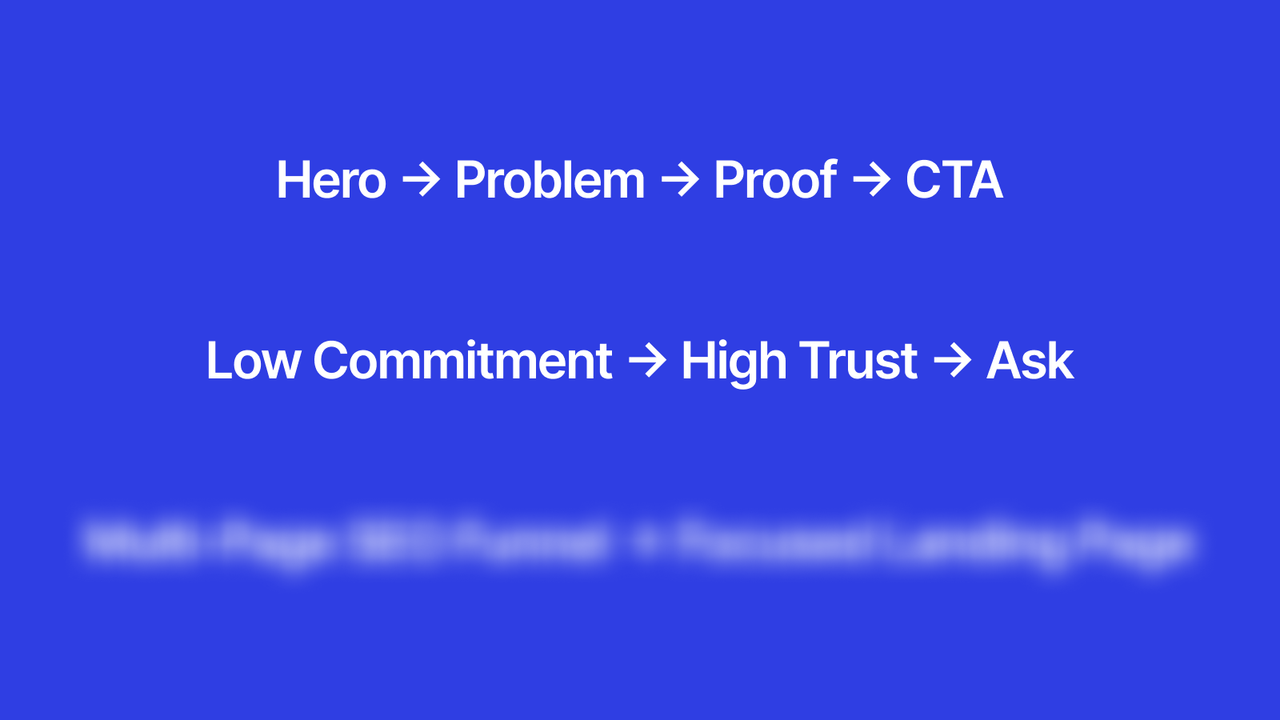
Strategy 1: Hero → Problem → Proof → CTA
The storytelling funnel approach
People don't decide on logic alone; they decide based on emotion + belief + fear + goals.
Telling a story from the "problem" they're facing toward the "hope" and the "proof that you can help" makes them feel, "This is someone who understands us."
Page structure:
- Hero Section: communicate the promise clearly
→ e.g. "Grow your sales with a website designed to actually sell" - Highlight Pain Point: let them know you understand their problem
→ "Customers come to your site and then leave, never clicking to contact you?" - Show Proof & Solution: reviews, results, or portfolio
→ "Client A revamped their page and bookings grew 3x in 30 days" - Strong CTA: use language that benefits them, e.g.
→ "Book a free consultation to analyze your website"
Strategy 2: Low Commitment → High Trust → Ask
Don't sell right away; give something first
People don't like feeling sold to; they like the feeling that "we chose to buy ourselves."
Start by giving something useful first, such as a checklist, a guide, or advice. When they feel that you "give good things without expecting anything in return" → trust forms.
Funnel:
- Landing page giving something away for free
→ e.g. "Download 7 ways to make a website that sells (free PDF)" - Follow up with email automation
→ give more knowledge and gradually introduce your service - A soft CTA with a special offer
→ e.g. "There are 3 free consultation slots left this month"
Strategy 3: Multi-Page SEO Funnel → Focused Landing Page
"Carpet" the ground with many keywords, then bring people to the sales page
When people search for something on Google, they don't all type the same words.
Some search "restaurant website design," some search "how to increase sales from a website," some search "easy booking website."
If your site has many pages focused on many keywords, it's like fishing by casting lines at many spots.
And in the end everyone is led to the landing page that focuses on converting traffic into customers.
Funnel:
- SEO-friendly blog/service pages: have articles or service pages targeting each keyword group, such as
- "Booking website for clinics"
- "Restaurant website design that sells"
- A clear CTA on every page: linking to the landing page that matches what they're interested in
- A landing page with conversion design: the image, the copy, and the button all designed to make it easy to click or fill in the form
If you want your website to "bring people in to buy or use your service" more effectively, try designing your funnel to match the psychology of decision-making.
Strategy 1: arrange the story so people get drawn in → believe → click
Strategy 2: give before you sell → build trust
Strategy 3: pave the way with SEO → catch people with the right page
If you'd like me to help analyze your existing funnel, or design a funnel specifically for your business, feel free to reach out and chat first.